How to Tell if a Card Is First Edition
Last updated: · 8 min read
Base Set holo prices today
Current market prices for the Base Set holos, ungraded. Our price data lists one price per card for these sets, so 1st Edition copies, which sell for much more, aren't priced separately here: check the card's eBay sold listings for those.
Base Set
| No. | Card | Market price |
|---|---|---|
| 4/102 | Charizard | $954.65 |
| 2/102 | Blastoise | $227.27 |
| 15/102 | Venusaur | $151.66 |
| 10/102 | Mewtwo | $84.79 |
| 1/102 | Alakazam | $72.57 |
| 14/102 | Raichu | $62.51 |
| 6/102 | Gyarados | $56.33 |
| 3/102 | Chansey | $55.78 |
| 16/102 | Zapdos | $50.27 |
| 5/102 | Clefairy | $46.46 |
| 11/102 | Nidoking | $41.26 |
| 12/102 | Ninetales | $40.09 |
| 13/102 | Poliwrath | $34.64 |
| 9/102 | Magneton | $31.75 |
| 7/102 | Hitmonchan | $18.77 |
Base Set (Shadowless)
| No. | Card | Market price |
|---|---|---|
| 4/102 | Charizard | $2,172.24 |
| 2/102 | Blastoise | $896.06 |
| 15/102 | Venusaur | $494.19 |
| 1/102 | Alakazam | $323.42 |
| 10/102 | Mewtwo | $295.08 |
| 14/102 | Raichu | $244.83 |
| 12/102 | Ninetales | $172.83 |
| 11/102 | Nidoking | $172.19 |
| 5/102 | Clefairy | $169.66 |
| 13/102 | Poliwrath | $158.64 |
| 16/102 | Zapdos | $136.74 |
| 6/102 | Gyarados | $117.27 |
| 7/102 | Hitmonchan | $101.25 |
| 3/102 | Chansey | $95.75 |
| 9/102 | Magneton | $83.12 |
"Is it first edition?" is the most common question anyone asks about an old card, and the answer can mean the difference between a few dollars and a few thousand. The good news is that you can usually settle it in under a minute, without any tools, once you know where to look. This guide covers how first edition works in Pokémon, Yu-Gi-Oh! and Magic, the look-alikes that fool people, and what to do once you know.
What "first edition" actually means
A first edition card comes from the first print run of a set, and the publisher marked it as such on the card itself. Later print runs of the same set, usually called "unlimited", are otherwise the same card without the mark.
Two things follow from that. First, the mark is the whole test. If it isn't printed on the card, the card isn't first edition, however old it is or however early you bought it. Second, first edition is a property of particular sets in particular games. Most modern English sets in most games have never had a first edition at all, so a 2023 card can't be first edition no matter what a listing says.
Collectors pay more for first edition because the print runs were smaller and because the mark connects the card to the moment a set first came out. How much more depends heavily on the card and its condition. For some Pokémon holos the first edition premium is several times the unlimited price; for common cards it can be close to nothing.
Pokémon: the 1st Edition stamp
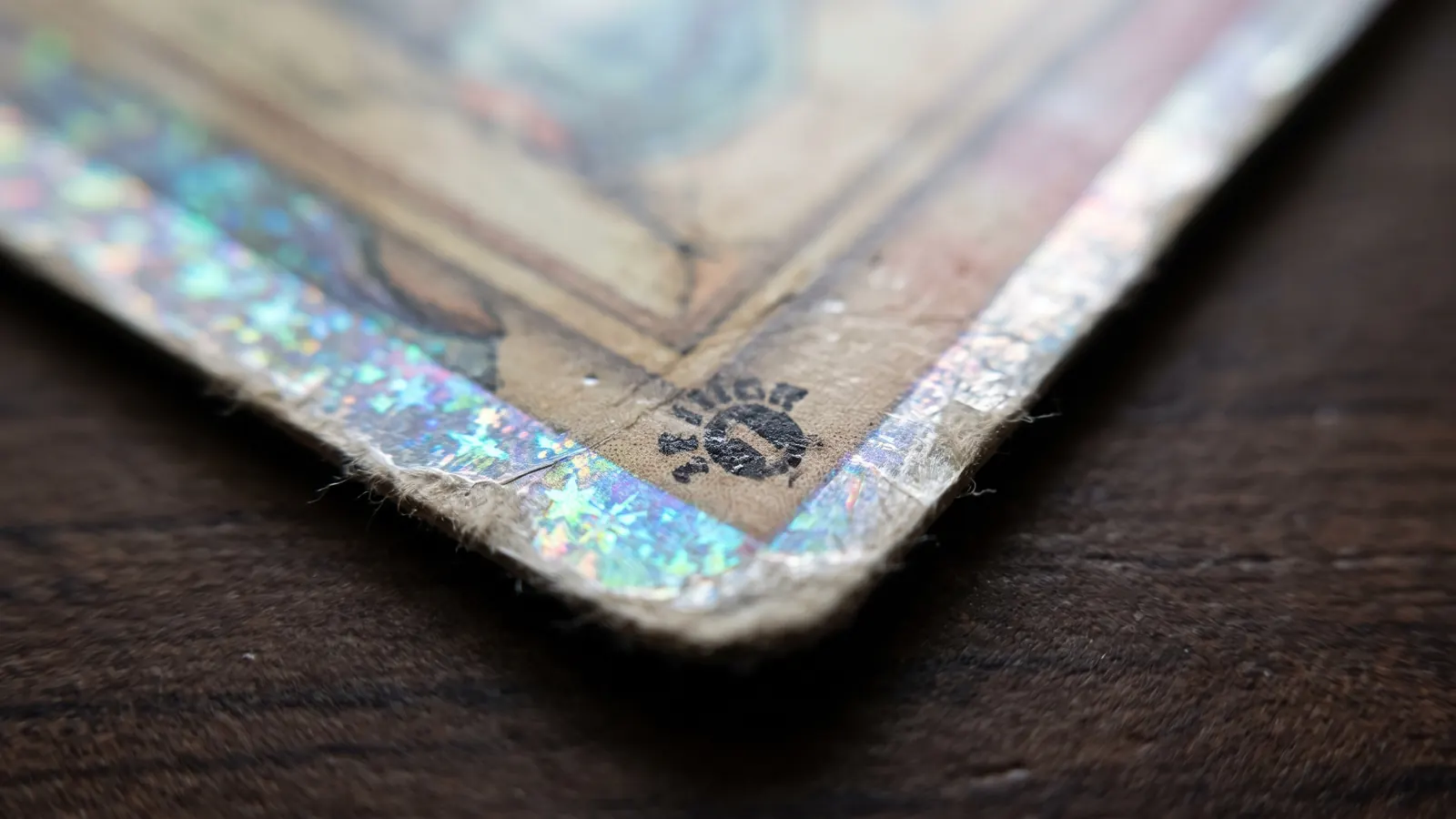
English Pokémon cards printed by Wizards of the Coast between 1999 and 2001 are the ones where first edition matters. On those cards, the mark is a small black circular stamp with a "1" in the middle and the word "EDITION" curving around it.
Where to look: on the front of the card, just below the bottom-left corner of the artwork box, to the left of the line of text that gives the Pokémon's length and weight. The stamp is small (about the size of a pencil eraser) and printed in solid black.
The English sets that were printed with first edition copies are:
- Base Set
- Jungle
- Fossil
- Team Rocket
- Gym Heroes
- Gym Challenge
- Neo Genesis
- Neo Discovery
- Neo Revelation
- Neo Destiny
If your card is from one of those sets and has no stamp, it's an unlimited copy. If your card is from a set that isn't on the list (Base Set 2, Legendary Collection, the e-Card sets, or anything from the EX era onwards), there was no first edition print, so the question doesn't apply.
Base Set is a special case
Base Set had more distinct print runs than any later set, and collectors price them separately. From earliest to latest:
- 1st Edition. Has the stamp. Also "shadowless": the artwork box has no drop shadow along its right-hand edge.
- Shadowless unlimited. No stamp, but still no shadow on the art box. Printed briefly after the first edition run.
- Unlimited. No stamp, and the art box has a dark shadow down its right side, giving it a slightly 3D look. This is by far the most common Base Set print.
- Later unlimited prints. Some later runs, including UK prints, changed the Wizards copyright at the bottom of the card from "©1999" to "©1999-2000".
That gives you a quick test for any Base Set card. No shadow and a stamp: 1st Edition. No shadow and no stamp: shadowless. Shadow: unlimited. A Base Set card with a stamp and a shadow on the art box should make you suspicious, because the genuine first edition run was all shadowless.
Reprints that look like first edition
The cards that most often confuse people are official reprints made decades later:
- Celebrations Classic Collection (2021) reprinted a handful of famous cards, including Base Set Charizard, in the original layout. They carry a small 25th anniversary logo where the set symbol would normally be and have a modern copyright line. They don't have the 1st Edition stamp.
- 30th Celebration Classic Collection (2026) follows the same idea for the 30th anniversary. Check the set marking and the copyright line at the bottom, which give a reprint away.
- XY Evolutions (2016) reprinted Base Set Pokémon with the original art but in a modern card frame, so they are easy to tell apart.
These reprints are real cards with their own prices, and some are worth good money. They're just not first edition, and listings sometimes describe them as "vintage" or "original" by mistake or on purpose.
Fake stamps
Because the stamp adds so much value, people do add stamps to unlimited cards. Some checks:
- A genuine stamp sits flat under the card's surface gloss. A stamp sitting on top of the gloss, with a slightly raised or matte feel, is a warning sign.
- Look at it under a magnifier. A genuine stamp is printed with the rest of the card, so its edges have the same print texture. Ink pens and stickers look different up close.
- Check the shadow. A stamped Base Set card with a shadowed art box is not a genuine first edition.
- Check the set. A stamp on a card from a set that never had a first edition print is fake by definition.
For any card worth serious money, the safest proof is a slab from a major grading company, which checks authenticity as part of grading.
Japanese Pokémon cards
Japanese Pokémon cards have used first edition marks in some eras and not others, and the marks don't look like the English stamp. Some Japanese sets mark first print runs with "1st EDITION" text near the bottom of the card. Others have no first edition distinction at all.
The safest way to check a Japanese card is to compare it with a confirmed example from the same set. Look at the bottom-left corner of the front, where the set and edition markings sit on most Japanese cards. If you can't find a reliable example, treat "1st edition" claims on Japanese listings with caution until you can.
Yu-Gi-Oh!: printed "1st Edition" text
Yu-Gi-Oh! is the easiest game to check, because Konami prints the edition in plain words. On the front of the card, look directly below the artwork, on the left-hand side, just above the card's text box. You'll find one of:
- 1st Edition: first print run of a booster set or structure deck.
- Limited Edition: cards from tins, promotional products and some special sets. These were never printed in a first or unlimited version.
- Nothing at all: an unlimited print.
Unlike Pokémon, Yu-Gi-Oh! has kept marking first edition prints throughout its history, so a recent Yu-Gi-Oh! card can be first edition. The premium for first edition on modern Yu-Gi-Oh! cards is usually smaller than on older ones, because modern print runs are much larger.
Two Yu-Gi-Oh! details catch people out. First, the set code (for example, LOB-EN001) tells you the set and region, not the edition. Second, the very earliest English Yu-Gi-Oh! sets also had misprinted and regional variants, which collectors price separately from the first edition and unlimited copies.
Magic: The Gathering has no first edition stamp
Magic never used a first edition mark, but its earliest printings play the same role, and they can be told apart:
- Alpha (1993) is the first print run. Alpha cards have noticeably more rounded corners than any later Magic card.
- Beta followed shortly after with the standard corner radius. Alpha and Beta both have black borders.
- Unlimited reprinted the same cards with white borders.
So a black-bordered card from the original set with very round corners is Alpha; black-bordered with normal corners is Beta; white-bordered is Unlimited. Later collector products such as the 30th Anniversary Edition reprinted these designs with different card backs, which makes them easy to identify.
Other games
Most newer games don't have first edition prints. One Piece, Disney Lorcana, Digimon, Star Wars: Unlimited and Flesh and Blood instead mark special printings in other ways: foil treatments, alternate art, serial numbers or special rarities such as Lorcana's Enchanted cards. Flesh and Blood is an exception, because some of its early sets were released in distinct First Edition and Unlimited runs. For these games, check the set's listing on our set pages, where each printing is priced on its own.
What to do once you know
- Write down exactly what you have. The set, the card number, and the edition or printing. The number in the bottom corner (for example 4/102) pins the card to a set.
- Look up the right printing. On our card pages, every printing is listed with its own market price. Make sure you're reading the line that matches your card. A first edition holo and an unlimited holo of the same card can be hundreds of dollars apart.
- Check the condition honestly. Condition moves the price at least as much as edition does. Our condition guide explains how to assess a card yourself.
- Think about grading. For a first edition card in good shape, a professional grade both proves the card is real and often raises what buyers will pay. For damaged cards, grading costs can exceed any gain.
- Protect it now. Put the card in a soft sleeve and then a rigid top-loader before you handle it any further. Most damage to valuable cards happens after the owner realises what they have.
Quick checklist
| Game | What to look for | Where |
|---|---|---|
| Pokémon (English, 1999–2001) | Black circular "1 EDITION" stamp | Below the bottom-left corner of the artwork |
| Pokémon Base Set | Stamp, plus no shadow on the art box | Art box right edge |
| Yu-Gi-Oh! | "1st Edition" printed text | Below the artwork, left side |
| Magic | Alpha corners (very round), Beta black border, Unlimited white border | Corners and border |
| Most modern games | No first edition prints | — |
If you're still unsure, search for the card on MyTCGValue. The card page shows the official image of each printing, which is often the fastest way to compare.
Check a card's price now
Scan any card with the TCG Scanner app, or search 270,000 cards on this site. Free, no sign-up.