Pokémon Card Rarity Symbols: Chart and How to Read a Card
A Pokémon card's rarity symbol sits in the bottom corner next to the card number. A circle means Common, a diamond Uncommon and a black star Rare. Two black stars mean Double Rare, and gold stars mark Illustration, Special Illustration and Hyper Rares. Today a typical modern Special Illustration Rare sells for about $29.80, a Common about $0.16.
Last updated: · 10 min read
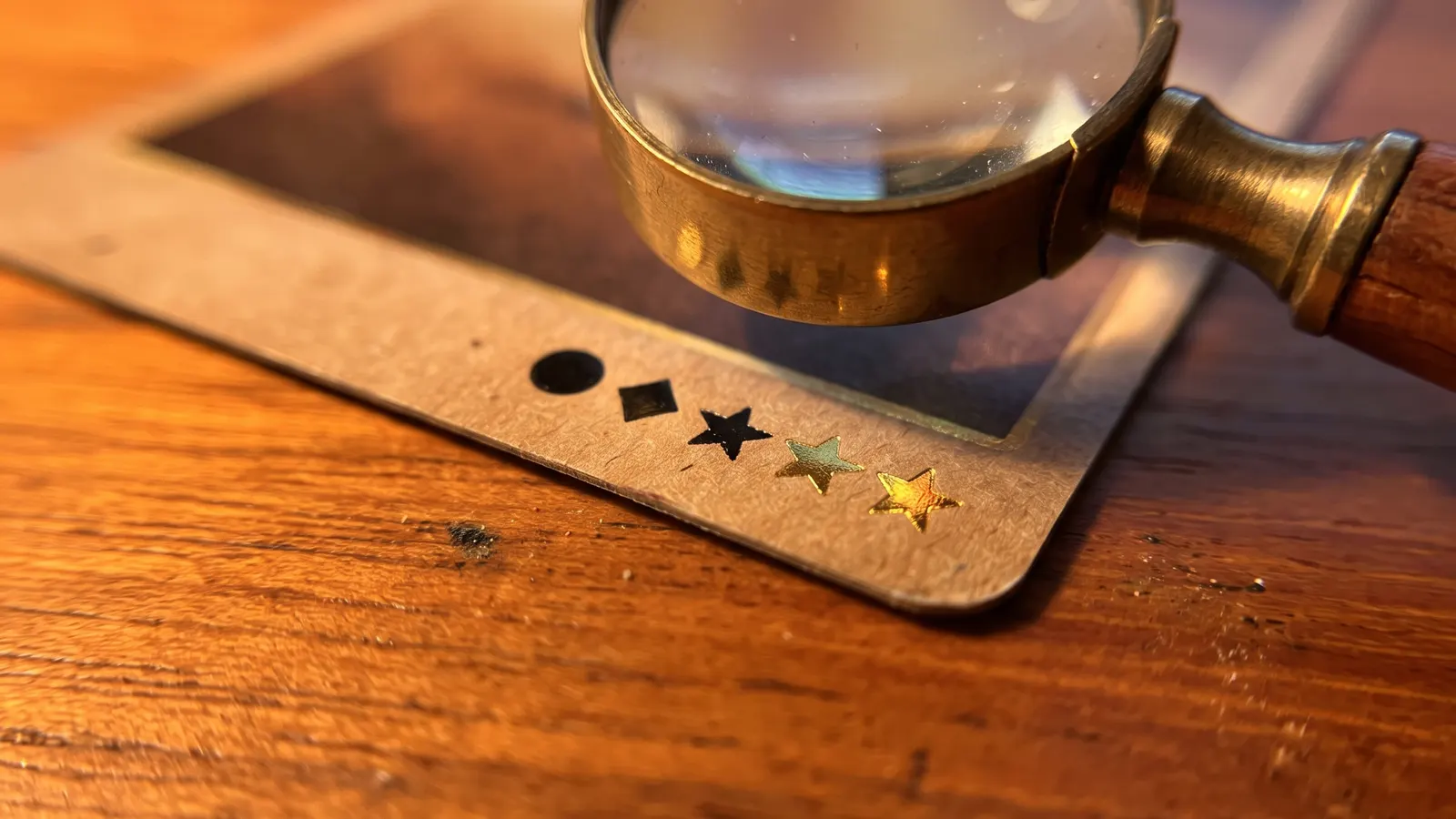
Every Pokémon card carries a small symbol along its bottom edge that tells you how hard it was to pull compared with the other cards in its set. Learning to read that symbol, along with the card number beside it, is the quickest way to sort a pile of cards into "probably bulk" and "worth a closer look". This guide covers every symbol from the 1999 Base Set to the current Mega Evolution sets, shows where each one sits on the card, and puts a live price on each rarity using the 28,059 English card printings in our database that have a recent market price.
Pokémon Rarity Symbols Chart
The chart below lists each rarity symbol that our sources describe, the eras it appears in, how the packs hand it out (in the words the sources use, since The Pokémon Company doesn't publish exact pull rates), and the median market price of an English card with that rarity in our data today. The median is the price of the typical card: half sell for more, half for less.
| Symbol | Rarity | Used in | How packs hand it out | Median price |
|---|---|---|---|---|
| Black circle | Common | Every era | Four or more in a normal recent booster pack | $0.29 |
| Black diamond | Uncommon | Every era | Three or more in a normal recent booster pack | $0.37 |
| One black star | Rare | Every era | At least one Rare or better in a normal recent pack | $0.89 |
| One black star, with a foil art box | Rare Holo | 1999 to January 2023 | Not published | $8.15 |
| Two black stars | Double Rare | Scarlet & Violet onwards | Sometimes in the rare slot | $0.92 |
| Two silver (white) stars since Scarlet & Violet; one white star before | Ultra Rare | EX series onwards | Sometimes in the rare slot | $7.44 |
| One gold star | Illustration Rare | Scarlet & Violet onwards | Sometimes in the second reverse holo slot | $10.40 |
| Two gold stars | Special Illustration Rare | Scarlet & Violet onwards | Sometimes in the second reverse holo slot | $29.80 |
| Three gold stars | Hyper Rare | Scarlet & Violet onwards | Sometimes in the second reverse holo slot | $7.53 |
| Its own Mega Hyper Rare symbol | Mega Hyper Rare | Mega Evolution | Not published | $154.53 |
| Two pastel stars, one pink and one green | Mega Attack Rare | Mega Evolution (from Ascended Heroes) | Not published | $4.86 |
| Outline of one gold star | Shiny Rare | Paldean Fates only | Not published | $4.60 |
| Outline of two gold stars | Shiny Ultra Rare | Paldean Fates only | Not published | $1.98 |
| A rainbow letter A | Amazing Rare | Sword & Shield | Not published | $4.06 |
| Black star with the word PROMO | Promo | Every era | Not found in normal booster packs | $9.13 |
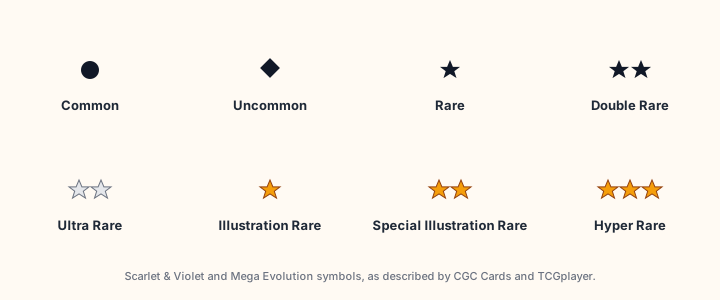
The three basic shapes have barely changed since 1999: a circle for Common, a diamond for Uncommon and a star for Rare. Everything above Rare is where the eras differ, so it helps to know which era your card comes from before you read its symbol.
Scarlet & Violet and Mega Evolution symbols
The Scarlet & Violet series, which began in March 2023, gave the higher rarities their own symbols for the first time, so a modern card's rarity can be read straight off the card:
- Black circle: Common.
- Black diamond: Uncommon.
- One black star: Rare.
- Two black stars: Double Rare. So far these have all been foil Pokémon ex cards.
- Two silver (white) stars: Ultra Rare. These are full-art cards, such as full-art Pokémon ex and full-art Trainers.
- One gold star: Illustration Rare, a foil alternate-art card of a Pokémon without a rule box (no ex), with the illustration covering the whole card.
- Two gold stars: Special Illustration Rare, the alternate-art versions of Pokémon ex and some Supporter cards.
- Three gold stars: Hyper Rare, the gold-bordered cards.
- Outline of one or two gold stars: Shiny Rare and Shiny Ultra Rare, which have only appeared in Paldean Fates.
- ACE SPEC Rare: powerful Trainer cards labelled ACE SPEC. A deck can hold only one ACE SPEC card.
The Mega Evolution series added two more. Mega Hyper Rares are fully gold, embossed Mega Pokémon with their own rarity symbol, and the Mega Attack Rares that arrived with Ascended Heroes in January 2026 use two pastel stars, one pink and one green. You can see several of these rarities side by side in our Ascended Heroes card list.
Sword & Shield and older symbols
Before 2023, the symbols did less of the work. A single star covered a whole range of rarities, and you had to look at the card's finish and number to tell them apart:
- One black star, no foil: Rare.
- One black star with a foil art box: Rare Holo (TCGplayer lists these as Holo Rare). This was the rarity just above Rare from 1999 until the end of the Sword & Shield series.
- One white star: anything from a Rare up to an Ultra Rare. Pokémon V, VMAX, VSTAR, GX, EX and LV.X cards all sit here, and so do full-art cards.
- A rainbow "A": Amazing Rare, a short-lived Sword & Shield rarity.
- A number above the set total: a Secret Rare. On a card numbered 201/198, the 198 is the size of the main set and anything above it was left out of the official count. Rainbow Rares and gold cards from the Sun & Moon and Sword & Shield years are Secret Rares by this rule.
Because a white star can mean so many things on these cards, the card number and the finish are what really tell you how rare a Sword & Shield card is.
Vintage WOTC symbols
The original sets printed by Wizards of the Coast, from Base Set in 1999 through the Neo sets and on to Skyridge in 2003, use only the circle, diamond and star. The rarest normal cards are the holo rares: a black star plus a holographic art box. The best-known example is Base Set Charizard, number 4/102.
On these cards, value depends far more on the printing than on the symbol. A 1st Edition stamp beside the art box, or a missing shadow along the art box border on early Base Set cards, can multiply the price of the same card. Our guide to telling if a card is 1st Edition shows what to look for. Promo cards from this era carry a black star with the word PROMO instead of a rarity symbol.
Not every card has a symbol at all. Basic Energy cards don't, and some products don't either. TCGplayer gives Dragon Vault and the McDonald's 25th Anniversary promos as examples. For those, the only sure way to learn the rarity is to look the card up in a database such as ours.
How to Read a Pokémon Card
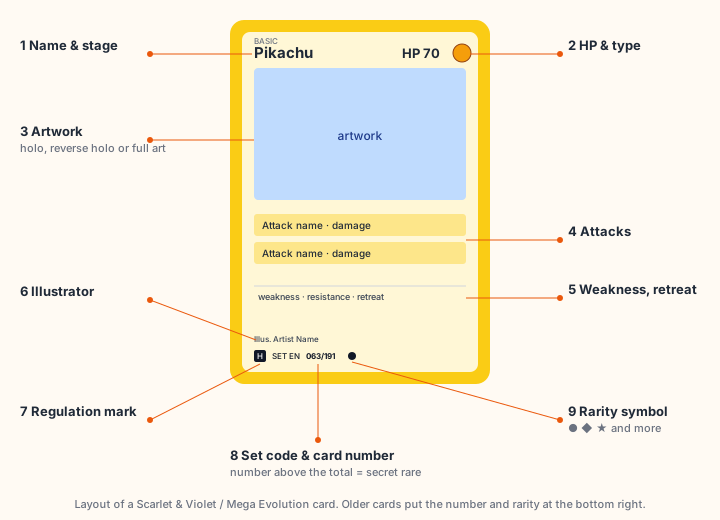
Everything you need to identify a card is printed on its front. The diagram shows where each part sits on a modern card, and the sections below explain what each one tells you.
Name, HP and type
The Pokémon's name runs across the top left, with its stage (Basic, Stage 1, Stage 2 and so on) just above or beside it. Suffixes after the name matter: "ex" in lower case marks a Pokémon ex, a powerful card that gives up two Prize cards when it is Knocked Out, while older cards use EX, GX, V, VMAX and VSTAR. On the top right you'll find the HP, which is how much damage the Pokémon can take, and its type symbol, such as Lightning or Fire. Trainer and Energy cards have a label in place of the HP.
Set symbol and card number
The card number is the most useful line on the card for working out exactly what you have. It is written as two numbers, such as 4/102: this card is number 4 in a set of 102. Search a card's name with its number, and you will usually find the exact printing.
When the first number is higher than the second, like 150/128, you have a secret rare: a card numbered beyond the official size of the set. Secret rares are usually the scarcest cards in a set, though not always the most valuable.
Next to the number, most cards show the set's symbol or, on modern cards, a short set code. This tells you which expansion the card came from, which matters because the same Pokémon is printed in dozens of sets at very different prices. The 1999 Base Set is the famous exception: it has no set symbol at all, which is one way to tell it apart from later reprints.
Rarity symbol
The rarity symbol sits right next to the card number. On Scarlet & Violet and Mega Evolution cards, the number and symbol are at the bottom left. On the WOTC-era cards from 1999 to 2003, they are at the bottom right. Layouts in between moved around, so if you can't find the symbol, check both bottom corners. On some full-art cards the silver symbol is printed on a white or busy background and is hard to see; tilt the card under a light.
Regulation mark and illustrator credit
Cards from the Sword & Shield series onwards carry a regulation mark: a single letter in a small box near the bottom left. It tells players which cards are legal in the Standard tournament format, which rotates over time. It has nothing to do with rarity or value, but it helps date a card to a period of releases.
The illustrator credit ("Illus." followed by a name) sits along the bottom edge. Collectors follow some artists closely, and that can affect demand for alternate-art cards, but the credit doesn't change a card's rarity.
Holo, reverse holo and full art finishes
The same card can come in several finishes, and the finish often matters more to the price than the symbol does:
- Non-holo: no foil at all. Most commons and uncommons.
- Holo: only the artwork window shines. In older sets this marked the Rare Holo cards.
- Reverse holo: foil across the whole card except the artwork. Most commons, uncommons and rares in a modern set have a reverse holo version, so a shiny card isn't automatically a rare one.
- Full art: the artwork covers the entire card and the whole card is foil. Full-art cards first appeared in the Black & White series.
We explain each finish and treatment in more detail, with live prices, in our guide to Pokémon card types: full art, illustration rare and SIR.
How to Tell If a Pokémon Card Is Rare
Run through these five checks, in this order, with the card in your hand:
- Find the rarity symbol. A circle or diamond means Common or Uncommon. A star means Rare or better. On a modern card, two or more stars, or any gold star, means a high rarity.
- Compare the card number with the set total. If the first number is bigger than the second (such as 150/128), it's a secret rare.
- Look at the finish. A holo art box, a full-art design, a textured surface or a gold border all point to a higher rarity. A reverse holo on its own doesn't.
- Check for era markers. On 1999–2003 cards, look for a 1st Edition stamp and, on Base Set, a missing shadow along the art box. These earlier printings are worth more than the same card from a later run.
- Look up the actual price. Rarity tells you how scarce a card is within its set, not what it sells for. Search the card's name and number, or scan it, and compare the live market price.
That last step matters more than any symbol. Popularity counts for a lot: a Pikachu or a Charizard can sell for more than a much rarer card of a Pokémon few people collect. Our guide to what makes a card valuable covers the other factors, from condition to playability.
What Is Each Rarity Worth?
Here is what each rarity is worth right now, measured across our database. The first table covers Scarlet & Violet and Mega Evolution sets only, so you can compare rarities that share the same symbol system. The second covers every era. For each rarity you'll see how many cards we track, the median market price and the most valuable card with that rarity.
| Rarity | Cards | Median price | Most valuable card | Price |
|---|---|---|---|---|
| Black White Rare | 4 | $567.10 | Victini | $622.40 |
| Mega Hyper Rare | 8 | $154.53 | Mega Charizard Y ex | $235.24 |
| Special Illustration Rare | 224 | $29.80 | Umbreon ex | $1,137.17 |
| Illustration Rare | 500 | $10.40 | Magikarp | $290.19 |
| Hyper Rare | 74 | $7.53 | Pikachu ex | $68.00 |
| Mega Attack Rare | 7 | $4.86 | Mega Gengar ex | $30.95 |
| Shiny Rare | 120 | $4.60 | Pikachu | $72.88 |
| Promo | 487 | $3.76 | Pikachu with Grey Felt Hat | $990.42 |
| Ultra Rare | 357 | $2.06 | Gengar ex | $51.92 |
| Shiny Ultra Rare | 12 | $1.98 | Mew ex | $31.48 |
| Classic Collection | 102 | $1.04 | Lugia | $196.70 |
| Double Rare | 327 | $0.69 | Mew ex - 205/165 (151 Metal Card) | $23.65 |
| ACE SPEC Rare | 33 | $0.49 | Hero's Cape | $24.57 |
| Rare Holo | 28 | $0.43 | Marnie's Morpeko | $48.43 |
| Rare | 493 | $0.22 | Umbreon (Master Ball Pattern) | $51.27 |
| Uncommon | 1,275 | $0.17 | Musharna (Master Ball Pattern) | $23.83 |
| Common | 1,948 | $0.16 | Maractus (Master Ball Pattern) | $24.96 |
| Futuristic Rare | 10 | $0.16 | Mew ex | $46.36 |
| Rarity | Cards | Median price | Most valuable card | Price |
|---|---|---|---|---|
| Mega Hyper Rare | 8 | $154.53 | Mega Charizard Y ex | $235.24 |
| Rainbow Rare | 36 | $38.67 | Charizard GX (Secret) | $840.75 |
| Special Illustration Rare | 224 | $29.80 | Umbreon ex | $1,137.17 |
| Secret Rare | 601 | $14.91 | Charizard | $2,999.99 |
| Prism Star | 33 | $14.27 | Darkrai Prism Star | $86.25 |
| Illustration Rare | 504 | $10.40 | Magikarp | $290.19 |
| Radiant Rare | 33 | $9.14 | Radiant Charizard | $328.02 |
| Promo | 3,934 | $9.13 | Rocket's Mewtwo - 8 [Winner] | $2,400.00 |
| Rare Holo | 1,902 | $8.15 | Charizard | $2,172.24 |
| Hyper Rare | 74 | $7.53 | Pikachu ex | $68.00 |
| Ultra Rare | 2,553 | $7.44 | Latias & Latios GX (Alternate Full Art) | $4,499.66 |
| Shiny Holo Rare | 246 | $5.97 | Ho-Oh (Shiny) | $833.32 |
| Rare ACE | 14 | $5.10 | Master Ball | $16.32 |
| Mega Attack Rare | 7 | $4.86 | Mega Gengar ex | $30.95 |
| Shiny Rare | 120 | $4.60 | Pikachu | $72.88 |
| Rare BREAK | 28 | $4.44 | Lugia BREAK | $48.66 |
| Amazing Rare | 9 | $4.06 | Rayquaza | $24.21 |
| Shiny Ultra Rare | 12 | $1.98 | Mew ex | $31.48 |
| Classic Collection | 132 | $1.73 | Lugia | $196.70 |
| ACE SPEC Rare | 58 | $1.57 | Unfair Stamp | $62.97 |
| Double Rare | 510 | $0.92 | Greninja ex (GameStop Metal Card) | $64.72 |
| Rare | 3,526 | $0.89 | Chimecho (Delta Species) | $900.00 |
| Uncommon | 6,653 | $0.37 | Dawn (Regional Championship) [Staff] | $668.49 |
| Common | 7,055 | $0.29 | Pikachu | $262.33 |
| Futuristic Rare | 10 | $0.16 | Mew ex | $46.36 |
A few patterns stand out. Most Commons and Uncommons are worth very little: 66% of the 7,009 priced Common cards in our database sell for under $0.50. In modern sets, prices climb steeply with the gold-star rarities. A typical Special Illustration Rare from Scarlet & Violet or Mega Evolution sells for about $29.80, against about $0.16 for a typical Common. The top of each rarity is a different story. Every rarity has outliers, and a popular Pokémon in a low rarity can outsell a forgettable one in a high rarity.
These are market estimates for ungraded cards, based on recent TCGplayer sales. They change every night as new sales come in, so treat them as a guide to today's market rather than a promise of what a card will sell for.
What Does SIR Mean on a Pokémon Card?
SIR stands for Special Illustration Rare. It is the rarity marked with two gold stars, introduced with the Scarlet & Violet series in 2023. SIRs are alternate-art cards where the illustration fills the whole card and often tells a small story: the Pokémon in its habitat, or a Trainer with their partner.
Most SIRs are Pokémon ex, though not all of them. In our data, 65 of the 224 Special Illustration Rares aren't Pokémon ex cards. The most valuable of those right now is Perrin from SV06: Twilight Masquerade. SIRs are among the most valuable cards in modern sets: right now the most valuable is Umbreon ex from SV: Prismatic Evolutions at about $1,137.17.
Collectors use a few other shorthand names you may see in listings. IR is an Illustration Rare (one gold star), and HR or "gold" is a Hyper Rare (three gold stars). "Alt art" is a general term for any alternate-art card, including the Sword & Shield cards that came before IRs and SIRs. For the rarest individual cards ever printed, rather than the rarest symbols, see our guide to the rarest Pokémon cards.
Check Your Card's Value
Once you've read the symbol and the number, the fastest way to find out what your card is worth is to look it up. Search by name and number below, or browse all Pokémon sets to find yours by its set symbol. You can also scan a whole stack at once with our free Pokémon card scanner app, which reads the card for you and shows its market price. For a step-by-step look at pricing a collection, see the Pokémon card value checker, and for the current top of the market, our live list of the most expensive Pokémon cards.
Look up your card
Frequently Asked Questions
What do the symbols on Pokémon cards mean?
The small symbol next to the card number shows the card's rarity within its set. A circle means Common, a diamond means Uncommon and a star means Rare. Modern cards add more stars for higher rarities: two black stars for Double Rare, silver stars for Ultra Rare and gold stars for Illustration, Special Illustration and Hyper Rares.
What is the rarest Pokémon card symbol?
In the Scarlet & Violet era it is three gold stars, the Hyper Rare, and the Mega Evolution series added Mega Hyper Rares with their own symbol. For the rarest individual cards ever made, see our guide to the rarest Pokémon cards.
What does SIR mean on a Pokémon card?
SIR means Special Illustration Rare, the rarity marked with two gold stars. These are full-card alternate-art versions of Pokémon ex and some Supporters, and a typical modern one sells for about $29.80 right now.
How do I know if my Pokémon card is rare?
Check three things: the rarity symbol (a star or more), the card number (a number above the set total means a secret rare) and the finish (holo art, full art or a gold border). Then look up the card's price, because rarity alone doesn't set its value.
Where is the rarity symbol on a Pokémon card?
Next to the card number along the bottom edge. Scarlet & Violet and Mega Evolution cards print it at the bottom left; the 1999–2003 Wizards of the Coast cards print it at the bottom right.
Are rare Pokémon cards always worth money?
No. Of the 3,514 cards with the Rare rarity in our database that have a market price, 52% sell for under $1. Popularity, age, condition and the exact printing matter as much as the symbol.
Sources
- CGC Cards: Understanding Pokémon Rarity Symbols and Card Features (symbols, Mega Hyper Rare and Mega Attack Rare, secret rares)
- TCGplayer: How to Tell the Rarity of a Pokémon Card (symbols by era, pack slots, cards without a symbol)
- Pokémon TCG rules (card layout and game terms)
- Bulbapedia: Rarity (further reading)
Card prices, counts and dates come from our own database of nightly US market prices from TCGplayer sales. They are market estimates for ungraded cards, change every day, and are not investment advice.
Check a card's price now
Scan any card with the TCG Scanner app, or search 270,000 cards on this site. Free, no sign-up.