PSA vs CGC vs BGS: Which Card Grading Company Should You Use?
PSA, CGC and BGS all grade cards from 1 to 10. On Oct 26, 2026, CGC's cheapest tier cost $17.00 a card against $59.99 for PSA's cheapest open tier, with shorter published turnarounds. CGC adds a Pristine 10 above Gem Mint; BGS prints four subgrades and a Black Label for perfect 10s. Choose based on your goal.
Last updated: · 6 min read
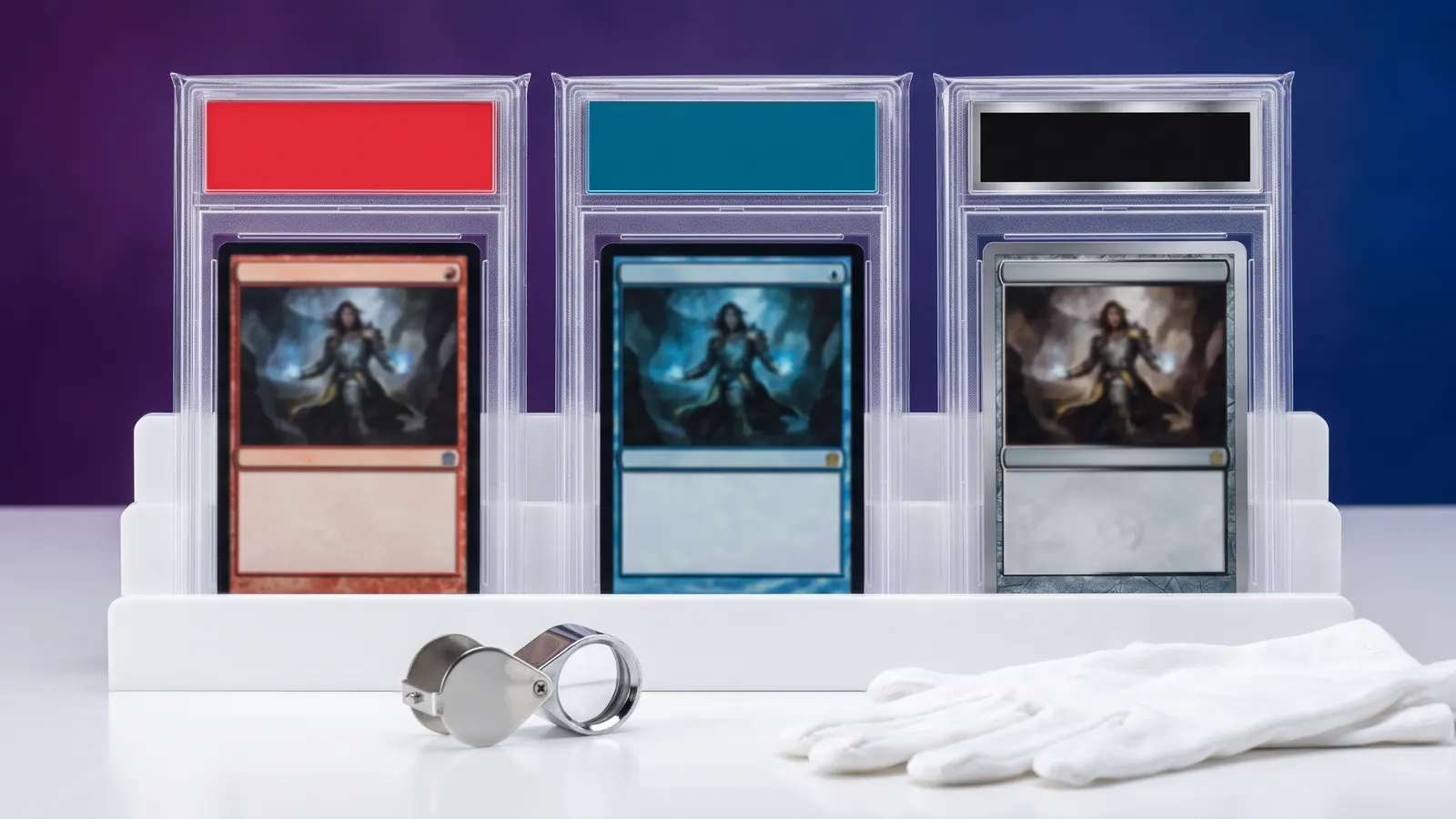
PSA, CGC and Beckett (BGS) are the three grading companies most collectors choose between for Pokémon, Magic and other trading cards. All three grade cards from 1 to 10 and seal them in a tamper-evident slab, but their scales, labels, prices and turnaround times differ. This guide compares them side by side, using each company's own published standards and prices, and helps you pick the right one for your card.
Quick Comparison Table
The PSA and CGC cells come from each company's own website. Fees and turnaround times were checked on Oct 26, 2026 and change often, so check the company's pricing page before you submit. We couldn't open Beckett's pages from our systems on that date, so their fee and turnaround cells point you to Beckett instead of quoting a figure.
| PSA | CGC | BGS (Beckett) | |
|---|---|---|---|
| Scale | 1 to 10 | 1 to 10 | 1 to 10 |
| Half grades | Between PSA 2 and PSA 9 only | Yes, from 1.5 to 9.5 | Yes |
| Top grades | Gem Mint 10 | Pristine 10, then Gem Mint 10 (Perfect 10 retired) | Black Label (all four subgrades 10), Pristine 10 |
| Subgrades | No | Not part of CGC's published grading scale | Centering, corners, edges, surface |
| Gem Mint centering | About 55/45 front, 75/25 back | About 55/45 front, 75/25 back (Pristine: 50/50) | See Beckett's site |
| Cheapest listed tier | Standard: $59.99 (lower Value tiers paused) | Bulk (25-card minimum): $17.00 | See Beckett's site |
| Published turnaround, cheapest tier | 90–100 business days | 150 working days | See Beckett's site |
| Crossover from other slabs | Listed as a service | Yes, add-on: re-slabbed only at the same grade or higher | See Beckett's site |
Grading Scales Side by Side
All three scales run from 1 to 10, but they name the grades differently and treat the top of the scale differently. This table lines up the published grade names for PSA and CGC:
| Grade | PSA | CGC |
|---|---|---|
| 10 | Gem Mint (GEM-MT) | Pristine 10 or Gem Mint 10 |
| 9.5 | — | Mint+ |
| 9 | Mint | Mint |
| 8 | Near Mint-Mint (NM-MT) | NM/Mint |
| 7 | Near Mint (NM) | Near Mint |
| 6 | Excellent-Mint (EX-MT) | Ex/NM |
| 5 | Excellent (EX) | Excellent |
| 4 | Very Good-Excellent (VG-EX) | VG/Ex |
| 3 | Very Good (VG) | Very Good |
| 2 | Good | Good |
| 1.5 | Fair (FR) | Fair |
| 1 | Poor (PR) | Poor |
PSA Grading Scale
PSA grades from 1 (Poor) to 10 (Gem Mint). Its published standards describe a PSA 10 Gem Mint as "a virtually perfect card" with four sharp corners, sharp focus and full original gloss, centered within about 55/45 on the front and 75/25 on the back. A PSA 9 Mint is allowed one minor flaw, such as a minor printing imperfection or slightly off-white borders, with centering of about 60/40 or better on the front and 90/10 on the back.
PSA gives half-point grades between PSA 2 and PSA 9 to cards that show high-end qualities within their grade, with a clear focus on centering. There is no PSA 9.5. PSA also uses "Authentic" for genuine cards it won't give a number, and "Authentic Altered" for genuine cards that show trimming, recolouring or other alterations. Our guide to PSA 10 vs PSA 9 explains why that one-point gap often makes such a difference to price.
CGC Pristine 10 vs Perfect 10 vs PSA 10
CGC has two 10s today. A CGC Gem Mint 10 is a card that earns a 10 overall but misses one of the Pristine requirements. Its published centering limits are the same as a PSA 10: about 55/45 on the front and 75/25 on the back. A CGC Pristine 10 is a step above. CGC describes it as virtually flawless to the naked eye, with 50/50 centering and flawless colour and registration, and its special Pristine label is reserved for cards that are flawless under 10-times magnification.
Perfect 10 is a legacy CGC grade. CGC's grading scale lists it as retired, though cards that received it keep their Perfect 10 status. If you see a "CGC Perfect 10" for sale, it was graded under the older scale.
So how does a CGC Pristine 10 compare with a PSA 10? On paper, Pristine is the stricter standard, because it requires perfect centering and a flawless card under magnification, while PSA 10 and CGC Gem Mint 10 allow some off-centre printing. Whether buyers pay more for one or the other is a market question, covered below.
BGS Black Label vs PSA 10
Beckett grades in half points from 1 to 10 and is known for subgrades: four separate scores for centering, corners, edges and surface, printed on the label. The overall grade comes from those four scores. A BGS Pristine 10 is a 10 overall, and the rare Black Label goes to cards that score a perfect 10 in all four subgrades. That makes a Black Label one of the hardest grades in the hobby to earn. Because we couldn't open Beckett's own grading scale page to confirm the details on the date we checked, read Beckett's scale for its exact definitions.
A PSA 10 has no subgrades, so the label doesn't tell a buyer which part of the card was strongest or weakest. Some collectors prefer that simplicity, while others like the extra detail of BGS subgrades.
Does CGC Grade Harder Than PSA?
You'll find strong opinions both ways, and most are based on people's own submissions, which are small samples. What we can compare are the published standards, and on paper they're close: a CGC Gem Mint 10 and a PSA 10 have the same centering limits. CGC adds Pristine 10 above that, so getting CGC's top grade is harder than getting its Gem Mint 10.
What isn't published anywhere we could verify is how often each company gives a 10 to the same quality of card. Population reports show how many cards each company has graded at each grade, but they can't tell you whether two companies would grade the same card differently, because different cards were sent to each. Treat claims that one company is "always harder" as anecdotes, not facts.
Resale Value: Which Slab Sells for More?
This is the question that matters most if you're grading to sell, and it's also where good data is hardest to find. We don't track graded prices, and we won't present our ungraded prices as graded ones or invent a multiplier between companies. The honest way to answer it for your card is to compare recent sold listings for the same card, in the same grade, from each company. Asking prices aren't a reliable guide.
Graded records show how far apart raw and graded prices can be. Polygon reported in May 2024 that an Alpha Black Lotus graded a 10 by CGC sold privately for a record price, while the same card ungraded rarely sells at all. Here, for reference, are today's ungraded prices for three well-known cards:
| Card | Set | No. | Market price |
|---|---|---|---|
 Charizard | Base Set | 4/102 | $954.65 |
 Umbreon ex | SV: Prismatic Evolutions | 161/131 | $1,198.39 |
 Timetwister | Unlimited Edition | — | $6,400.00 |
A grade only adds value when the slabbed card sells for more than the raw card plus the grading fee, shipping and insurance. That depends heavily on the card, the grade it gets and which company graded it. Our card condition and grading guide covers how graders assess cards, and our condition guide helps you judge a card's condition before you send it.
Cost and Turnaround
These are the published fees and estimated turnaround times for each company's main card-grading tiers, as checked on Oct 26, 2026. Turnaround times are estimates, not guarantees, and CGC moves a card to a higher tier if it judges the card's value to be above the tier's limit.
| Company and tier | Fee per card | Max card value | Est. turnaround |
|---|---|---|---|
| PSA Standard | $59.99 | $1,000.00 | 90–100 business days |
| PSA Priority | $79.99 | $1,500.00 | 70–80 business days |
| PSA Express | $199.00 | $2,500.00 | 20–30 business days |
| PSA Super Express | $349.00 | $5,000.00 | 10–15 business days |
| PSA Premier | $599.00 | $10,000.00 | 7–10 business days |
| CGC Bulk (25-card minimum) | $17.00 | $500.00 | 150 working days |
| CGC Economy | $20.00 | $1,000.00 | 90 working days |
| CGC Standard | $55.00 | $3,000.00 | 10 working days |
| CGC Express | $100.00 | $10,000.00 | 5 working days |
| CGC WalkThrough | $300.00 | $100,000.00 | 2 working days |
On the day we checked, PSA showed its lower-priced Value tiers as temporarily paused, so its cheapest available tier was Standard. CGC's Bulk tier has a 25-card minimum. Both companies charge extra for shipping and insurance. For a full breakdown, including extra costs and how declared value works, see our guide to how much it costs to grade a Pokémon card.
Crossing Over a CGC Slab to PSA
A "crossover" means sending a card that's already in one company's slab to another company to be re-graded. CGC offers it as an add-on: it evaluates a card in a PSA, Beckett or SGC holder, and only removes it and re-slabs it if it believes the card will receive the same grade or higher. Otherwise the card comes back in its original holder. CGC charges according to the grading tier.
PSA also lists a Crossover service for cards graded by other companies. We couldn't confirm its current terms in detail, so check PSA's site before sending a CGC slab. Whichever direction you go, a crossover isn't guaranteed to keep the grade, and you pay the fee either way.
Which Should You Pick?
There's no single best grading company. It depends on what you want from the slab:
- You plan to sell a valuable card. Compare recent sold prices for your card in each company's slab at the grade you expect, then choose the one buyers pay most for. The answer differs from card to card.
- You want the lowest cost or a quick turnaround. On the date we checked, CGC's tiers were cheaper per card at the low end and its published turnaround times were shorter.
- You're chasing a perfect grade. CGC's Pristine 10 and BGS Black Label recognise flawless cards above a standard Gem Mint 10.
- You want detail. BGS subgrades show exactly where a card lost points.
- The card is worth little raw. Don't grade it unless it's for your own collection: the fee can be more than the card is worth.
Before you send anything, run your card through our should I grade it? calculator. It uses the card's live price to show whether a likely grade would cover the cost. You can find any card's current raw price with our Pokémon card value checker, and read where our prices come from to see what they measure.
Frequently Asked Questions
Is CGC better than PSA?
Neither is better for every card. On Oct 26, 2026, CGC was cheaper at the low end and quoted shorter turnaround times, and it offers a Pristine 10 above Gem Mint. If you're selling, compare what your card sells for in each company's slab before choosing.
Does CGC grade harder than PSA?
On paper they're close: CGC Gem Mint 10 and PSA 10 have the same published centering limits, and CGC's Pristine 10 is stricter than both. Claims that one company always grades harder come from personal submissions and aren't backed by published data.
Is a CGC Pristine 10 better than a PSA 10?
By the published standards, yes: Pristine 10 requires 50/50 centering and a card that is flawless under magnification, while a PSA 10 allows about 55/45 centering. What a buyer will pay for each varies by card, so compare sold prices for your card.
PSA vs BGS: which is better for Pokémon cards?
BGS gives four subgrades and a Black Label for perfect cards; PSA gives a single grade. If you want detail or are chasing a perfect grade, BGS suits you; if you want the simplest label, PSA does. Check recent sold prices for your card in both slabs.
Can you cross over a CGC card to PSA?
PSA lists a Crossover service for cards in other companies' slabs; check its current terms before sending. CGC's own crossover add-on works the other way and only re-slabs a card if it expects the same grade or higher.
Which grading company is cheapest?
On Oct 26, 2026, CGC's Bulk tier was $17.00 per card (25-card minimum), while PSA's cheapest open tier was $59.99, with its Value tiers paused. Fees change often, so check each company's pricing page.
Sources
- PSA: Grading Standards (grade definitions, centering, half-point grades)
- PSA: Trading card grading services and pricing (fees and turnaround, checked 2026-10-26)
- CGC Cards: Grading Scale (grade definitions, Pristine 10, retired Perfect 10)
- CGC Cards: Services & Fees (fees, turnaround and CrossOver, checked 2026-10-26)
- Beckett: Grading scale (BGS subgrades and Black Label; we couldn't open this page from our systems)
- Polygon: Black Lotus sells for $3 million (May 2024 graded sale)
Card prices, counts and dates come from our own database of nightly US market prices from TCGplayer sales. They are market estimates for ungraded cards, change every day, and are not investment advice.
Check a card's price now
Scan any card with the TCG Scanner app, or search 270,000 cards on this site. Free, no sign-up.